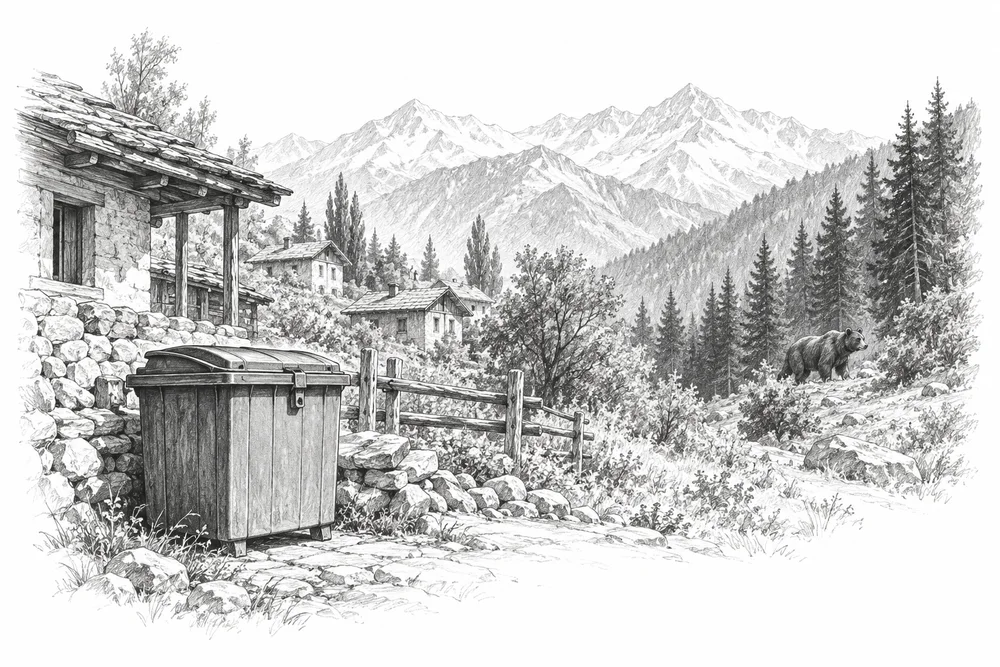
Prioritise secure food-waste handling around bear landscapes such as Sonamarg and monitor behaviour changes.
Stage
Scoping
Location
Kashmir Valley & catchments
Site
To be selected
Illustrative pencil study
UNDERSTANDING THE ISSUE
The problem
Reports from Sonamarg identify food waste as a conservation concern around bears. Access to discarded food can draw wildlife toward people; the current records do not justify a universal percentage claim about bear diets.
The first phase would turn this broad issue into a bounded site investigation. Current condition, the cause of change and an accountable local partnership would guide whether an intervention is appropriate.
Why this matters
Species-specific needs
Habitat, movement and exposure differ between species and landscapes.
Shared landscapes
Local livelihoods and public safety are part of an effective conservation response.
Reliable records
Verified observations help direct effort while avoiding disturbance and protecting sensitive locations.
PROPOSED APPROACH
A first investigation: wildlife attracted to garbage
Prioritise secure food-waste handling around bear landscapes such as Sonamarg and monitor behaviour changes.
01
Understand the site
Map accessible food-waste points, collection routines and wildlife observations with the responsible operators.
02
Shape a bounded trial
Test secure storage and dependable collection at a small cluster of premises.
03
Follow what changes
Record container access, missed collections and wildlife encounters without attracting or approaching animals.
What this work could produce
A documented baseline
Map accessible food-waste points, collection routines and wildlife observations with the responsible operators. Keep methods, dates, source records and unresolved questions together.
A practical project brief
Test secure storage and dependable collection at a small cluster of premises. Identify responsibilities, permissions, costs and continuing care before proceeding.
A repeatable observation plan
Record container access, missed collections and wildlife encounters without attracting or approaching animals. State what would count as success, failure or a reason to change course.
Local evidence
Evidence & references
A locally relevant topic is documented by a cited source; current severity and site feasibility remain unassessed.
Organisation's own research update checked through indexed excerpt. Reference checked 2026-10-30. Site, time period and methods limit how this evidence can be applied to a new project.
Approaches from elsewhere
These references offer methods to assess locally. They do not establish what will work at a selected Kashmir site.
World Bank; includes Waste Warriors cases · India, Nepal and Pakistan
Collection, sorting, viable recovery and community-based mountain waste systems. Case description is not proof of local replication or adequate local end markets.
Sagarmatha Pollution Control Committee and Sagarmatha Next · Nepal
Visitor and guide participation in recyclable waste transport. Requires safe sorting, a receiving recycler and workable logistics; do not transfer hazardous waste to visitors.
NEXT STEPS
Define the first investigation
Which food-waste point can be made consistently inaccessible to wildlife?