Identify local burning sources and pair behaviour change with workable collection or material-use alternatives.
Stage
Scoping
Location
Kashmir Valley & catchments
Site
To be selected
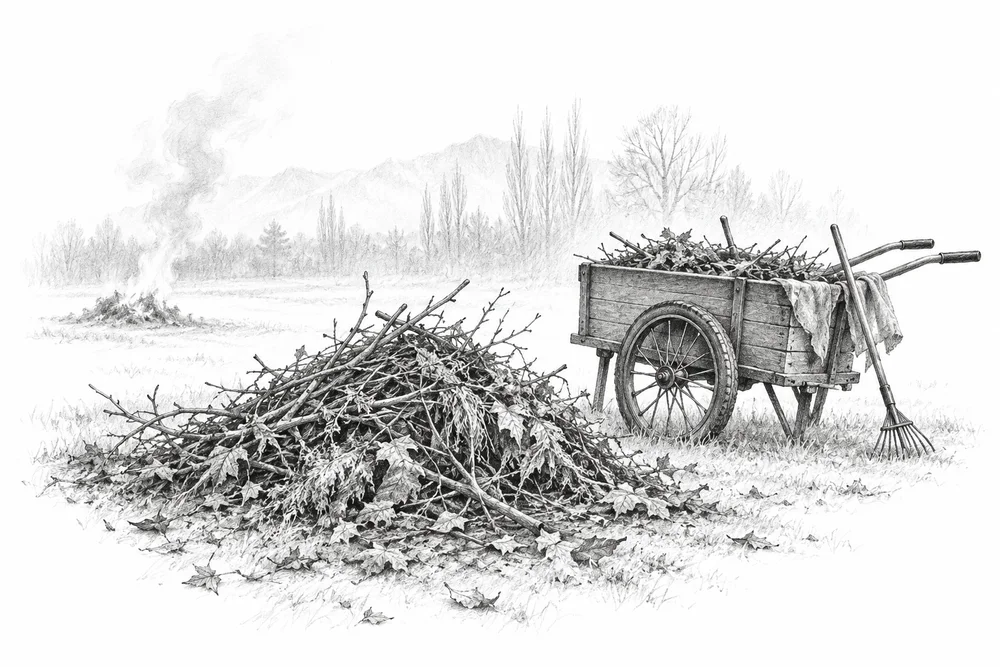
Illustrative pencil study
UNDERSTANDING THE ISSUE
The problem
Burning waste or residues can add to local air pollution. Srinagar black-carbon research shows that local and transported sources both matter; the share attributable to a particular burning practice needs evidence before benefits are claimed.
The first phase would turn this broad issue into a bounded site investigation. Current condition, the cause of change and an accountable local partnership would guide whether an intervention is appropriate.
Why this matters
Preventing repeated leakage
Understanding where material escapes is necessary to keep a cleaned site from being polluted again.
Complete material routes
Collection needs a suitable receiving destination and dependable handover.
Routine operation
People, resources and service reliability determine whether the system continues to work.
PROPOSED APPROACH
A first investigation: open waste and residue burning
Identify local burning sources and pair behaviour change with workable collection or material-use alternatives.
01
Understand the site
Identify recurring material streams, reasons for burning and available collection or reuse alternatives.
02
Shape a bounded trial
Pair a feasible alternative with the responsible users and service providers.
03
Follow what changes
Record the targeted burning events and material diversion, with air measurements only where interpretable.
What this work could produce
A documented baseline
Identify recurring material streams, reasons for burning and available collection or reuse alternatives. Keep methods, dates, source records and unresolved questions together.
A practical project brief
Pair a feasible alternative with the responsible users and service providers. Identify responsibilities, permissions, costs and continuing care before proceeding.
A repeatable observation plan
Record the targeted burning events and material diversion, with air measurements only where interpretable. State what would count as success, failure or a reason to change course.
Local evidence
Evidence & references
A locally relevant topic is documented by a cited source; current severity and site feasibility remain unassessed.
Publisher indexed abstract checked. Reference checked 2026-10-30. Site, time period and methods limit how this evidence can be applied to a new project.
Comptroller and Auditor General of India · Report 6 of 2025
J&K ULBs; includes Kashmir; audit period to March 2022
Official chapter listing and indexed report excerpts checked. Reference checked 2026-10-30. Site, time period and methods limit how this evidence can be applied to a new project.
Approaches from elsewhere
These references offer methods to assess locally. They do not establish what will work at a selected Kashmir site.
World Bank; includes Waste Warriors cases · India, Nepal and Pakistan
Collection, sorting, viable recovery and community-based mountain waste systems. Case description is not proof of local replication or adequate local end markets.
Landcare movement / Australian Government · Australia