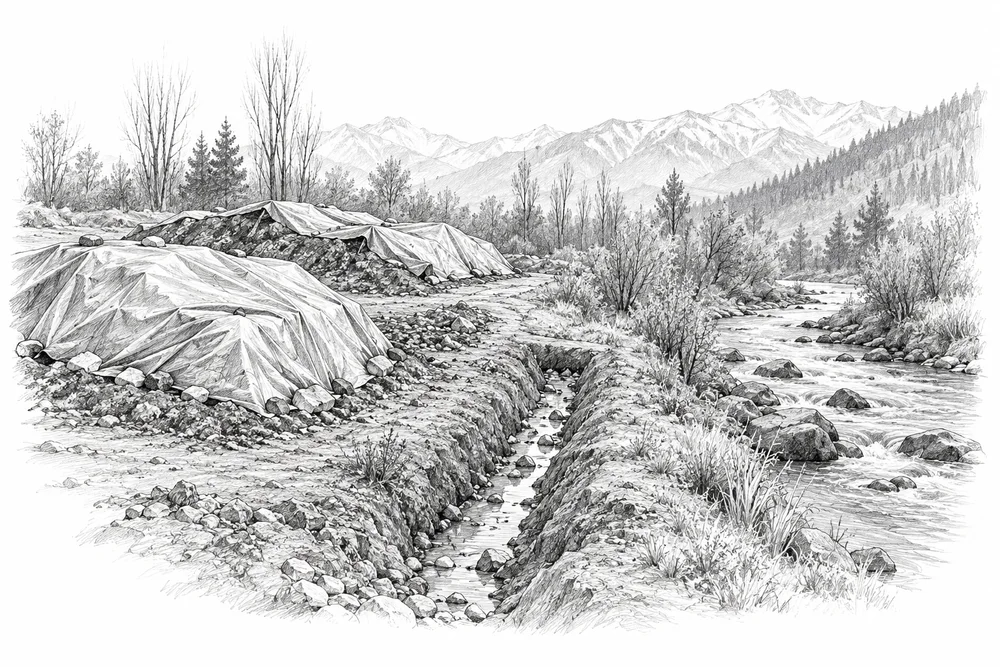
Build a small collection-and-prevention system with a verified destination for every material stream.
Stage
Scoping
Location
Kashmir Valley & catchments
Site
To be selected
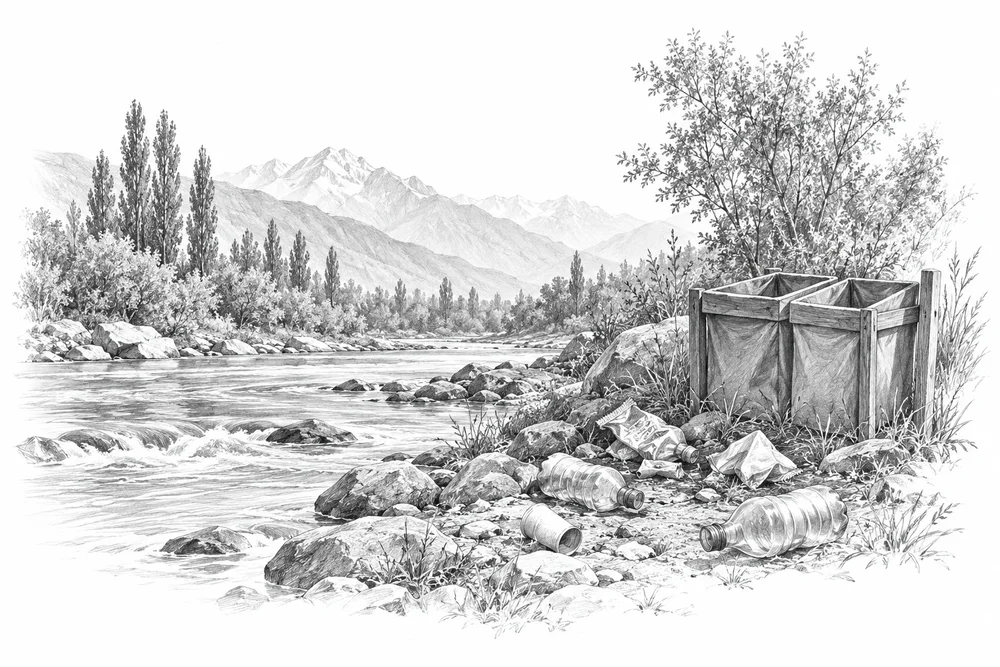
Illustrative pencil study
UNDERSTANDING THE ISSUE
The problem
Litter removal is temporary if material continues to leak from the same collection gap. The waste audit provides regional context, while a conservation project needs to establish the sources and verified destinations of each material stream at its own site.
The first phase would turn this broad issue into a bounded site investigation. Current condition, the cause of change and an accountable local partnership would guide whether an intervention is appropriate.
Why this matters
Preventing repeated leakage
Understanding where material escapes is necessary to keep a cleaned site from being polluted again.
Complete material routes
Collection needs a suitable receiving destination and dependable handover.
Routine operation
People, resources and service reliability determine whether the system continues to work.
PROPOSED APPROACH
A first investigation: litter, dumping and plastic leakage
Build a small collection-and-prevention system with a verified destination for every material stream.
01
Understand the site
Audit litter composition, dumping points and the existing collection and receiving chain.
02
Shape a bounded trial
Build one dependable prevention-and-collection arrangement with businesses, users and the local body.
03
Follow what changes
Track repeat litter counts, collection reliability and records of material receipt.
What this work could produce
A documented baseline
Audit litter composition, dumping points and the existing collection and receiving chain. Keep methods, dates, source records and unresolved questions together.
A practical project brief
Build one dependable prevention-and-collection arrangement with businesses, users and the local body. Identify responsibilities, permissions, costs and continuing care before proceeding.
A repeatable observation plan
Track repeat litter counts, collection reliability and records of material receipt. State what would count as success, failure or a reason to change course.
Local evidence
Evidence & references
A locally relevant topic is documented by a cited source; current severity and site feasibility remain unassessed.
Comptroller and Auditor General of India · Report 6 of 2025
J&K ULBs; includes Kashmir; audit period to March 2022
Official chapter listing and indexed report excerpts checked. Reference checked 2026-10-30. Site, time period and methods limit how this evidence can be applied to a new project.
Indexed primary-study abstract checked. Reference checked 2026-10-30. Site, time period and methods limit how this evidence can be applied to a new project.
Approaches from elsewhere
These references offer methods to assess locally. They do not establish what will work at a selected Kashmir site.
World Bank; includes Waste Warriors cases · India, Nepal and Pakistan
Collection, sorting, viable recovery and community-based mountain waste systems. Case description is not proof of local replication or adequate local end markets.
Separate collection, reuse and waste prevention. Historical case and targets; no claim that a dated 2025 target was achieved or that Kashmir has the same municipal capacity.
NEXT STEPS
Define the first investigation
Where does each collected material go, and can that route stay reliable?