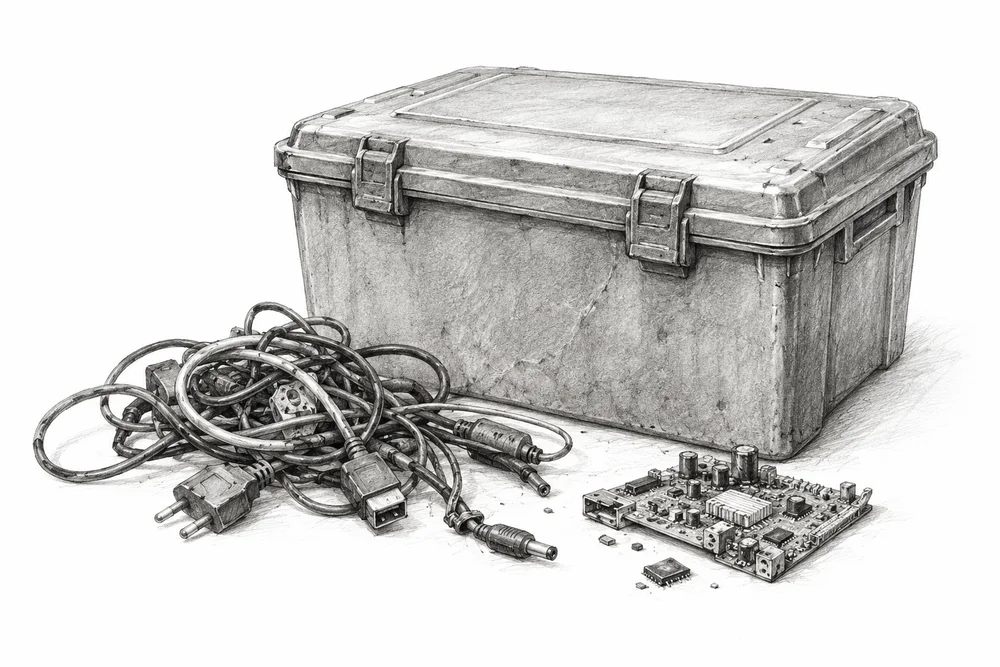
Verify the actual waste streams and strengthen handover to authorised specialist handlers where gaps are found.
Stage
Scoping
Location
Kashmir Valley & catchments
Site
To be selected
Illustrative pencil study
UNDERSTANDING THE ISSUE
The problem
Electronic, biomedical and other hazardous wastes require different authorised handling systems. The current source set does not establish leakage at a selected location; an initial project should verify the stream and strengthen legitimate handover arrangements.
This opportunity begins with checking whether the suspected problem is present and significant at a named site. A field baseline, the relevant technical partners and local priorities would determine whether CCK should develop it further.
Why this matters
Preventing repeated leakage
Understanding where material escapes is necessary to keep a cleaned site from being polluted again.
Complete material routes
Collection needs a suitable receiving destination and dependable handover.
Routine operation
People, resources and service reliability determine whether the system continues to work.
PROPOSED APPROACH
A first investigation: hazardous, electronic and biomedical waste leakage
Verify the actual waste streams and strengthen handover to authorised specialist handlers where gaps are found.
01
Understand the site
Review a defined institution's waste records and handling arrangements with its responsible staff.
02
Shape a bounded trial
Address a confirmed handover or storage gap with authorised specialist handlers.
03
Follow what changes
Track documented transfers, storage compliance and unresolved material streams.
What this work could produce
A documented baseline
Review a defined institution's waste records and handling arrangements with its responsible staff. Keep methods, dates, source records and unresolved questions together.
A practical project brief
Address a confirmed handover or storage gap with authorised specialist handlers. Identify responsibilities, permissions, costs and continuing care before proceeding.
A repeatable observation plan
Track documented transfers, storage compliance and unresolved material streams. State what would count as success, failure or a reason to change course.
To investigate
Evidence & references
Risk or delivery gap to investigate; listed sources supply context and do not establish its local extent.
Comptroller and Auditor General of India · Report 6 of 2025
J&K ULBs; includes Kashmir; audit period to March 2022
Official chapter listing and indexed report excerpts checked. Reference checked 2026-10-30. Context for screening; this source does not establish the local extent of the proposed issue.
Approaches from elsewhere
These references offer methods to assess locally. They do not establish what will work at a selected Kashmir site.
World Bank; includes Waste Warriors cases · India, Nepal and Pakistan
Collection, sorting, viable recovery and community-based mountain waste systems. Case description is not proof of local replication or adequate local end markets.
NEXT STEPS
Verify the local need
Which verified waste stream has a gap in authorised handover?